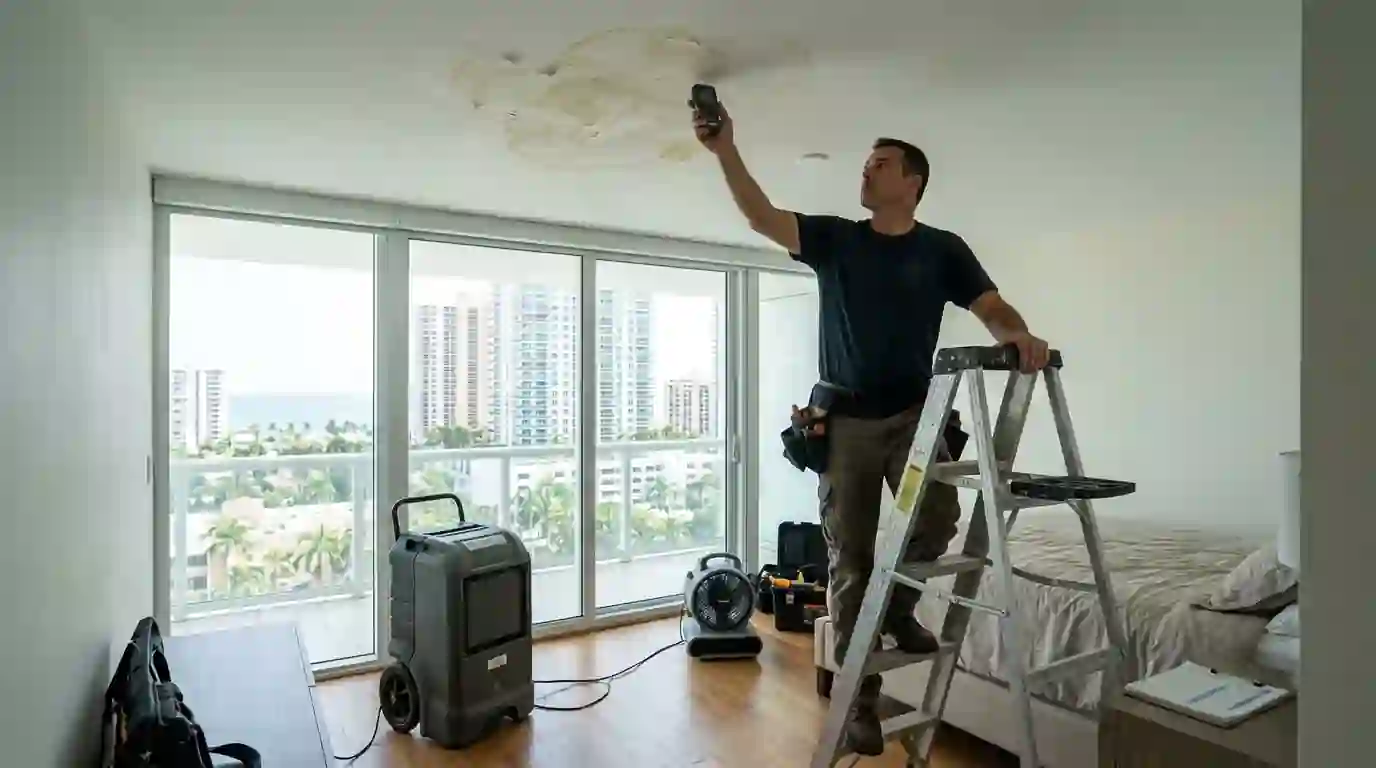
- Stop the water and start drying first; the payment question can be sorted out while the walls dry.
- Your declaration says which parts of the building the association maintains and which belong to the unit owner.
- The association's master policy and each owner's own policy usually cover different layers of the same loss.
- Photos, moisture readings and a clear record of where the water came from help every party.
Unit-to-unit leaks are a daily event in South Florida high-rises and garden condos. A supply line lets go on the twelfth floor, a shower pan fails, or a riser cracks inside a shared wall. The water does not care about property lines, and the cleanup has to start before anyone settles the question of responsibility.
This article explains how that question usually gets answered, in general terms. It is not legal advice. The answer for your building lives in your condominium declaration and your own insurance policy, and the right people to interpret those are the association's manager, your insurance agent or adjuster, and, if it comes to it, an attorney.
First, the water has to stop
Before anyone talks about who pays, someone has to stop the water. If the leak is inside your own unit, close the valve at the fixture or the unit shutoff. If it is coming from above, knock on the neighbor's door and call the building manager or maintenance staff at the same time. Many buildings can shut off a riser or a stack, and the staff usually have a way to reach an owner who is out of town.
Then document. Take photos of your ceiling, walls and floors, and ask your neighbor whether you can photograph the source in their unit. If the building engineer finds the cause, write down what they told you and when. These first notes carry a lot of weight later, when insurers and the board are working from memory and secondhand reports.
Where the leak started matters most
Responsibility for a condo leak almost always comes back to two facts: where the water came from, and which part of the building it damaged. A burst washer hose inside one unit is a different case from a corroded pipe inside a common wall, and both differ from a roof or window leak that lets rain into the building.
Your declaration of condominium, along with the bylaws and any rules the board has adopted, describes what counts as a unit and what counts as common elements. In many buildings the association maintains the structure, roof, exterior walls and shared pipes, while owners handle things inside their walls such as fixtures, appliances, cabinets and finishes. The exact dividing line varies building to building, so read the definitions sections rather than assuming.
How the insurance layers usually stack up
In most Florida condos there are at least two kinds of policy in play. The association carries a master policy on the building, and each owner carries a unit owner's policy, often called an HO-6, that typically addresses interior items and personal belongings. When a leak crosses units, two or three insurers may each look at their own part of the loss.
Neither policy is a blank check, and the wording matters. Ask your agent which parts of the unit your policy treats as yours, what your deductible is and whether you have loss assessment coverage. Report the loss to your insurer promptly even if you believe the neighbor or the association is at fault; your insurer can pursue the other party later if the facts support it.
A contractor cannot settle this for you. Florida law bars contractors from interpreting policy coverage or adjusting claims unless they hold a public adjuster license. What a restoration crew can do is document the damage carefully so the people who do decide coverage have clear facts. For policies issued on or after January 1, 2023, benefits also cannot be assigned to a contractor, so the claim stays in your name.
Common leak sources and the questions they raise
Every building is different, but these are the scenarios crews see most and the questions owners usually end up asking:
- Supply line, toilet or water heater failure in the unit above: was it a fixture the owner maintains, and does that owner's policy respond to damage below?
- Shower pan or tub leak: is the pan part of the unit, and how long had it been leaking before anyone noticed?
- AC condensate overflow: who owns and services the air handler and its drain line in your building? Our article on AC condensate leaks explains why these clog.
- Leak inside a shared wall or riser: does the declaration treat that pipe as a common element?
- Rain through a window, balcony door or roof: where does the declaration draw the line on exterior openings?
What good records look like for a condo job
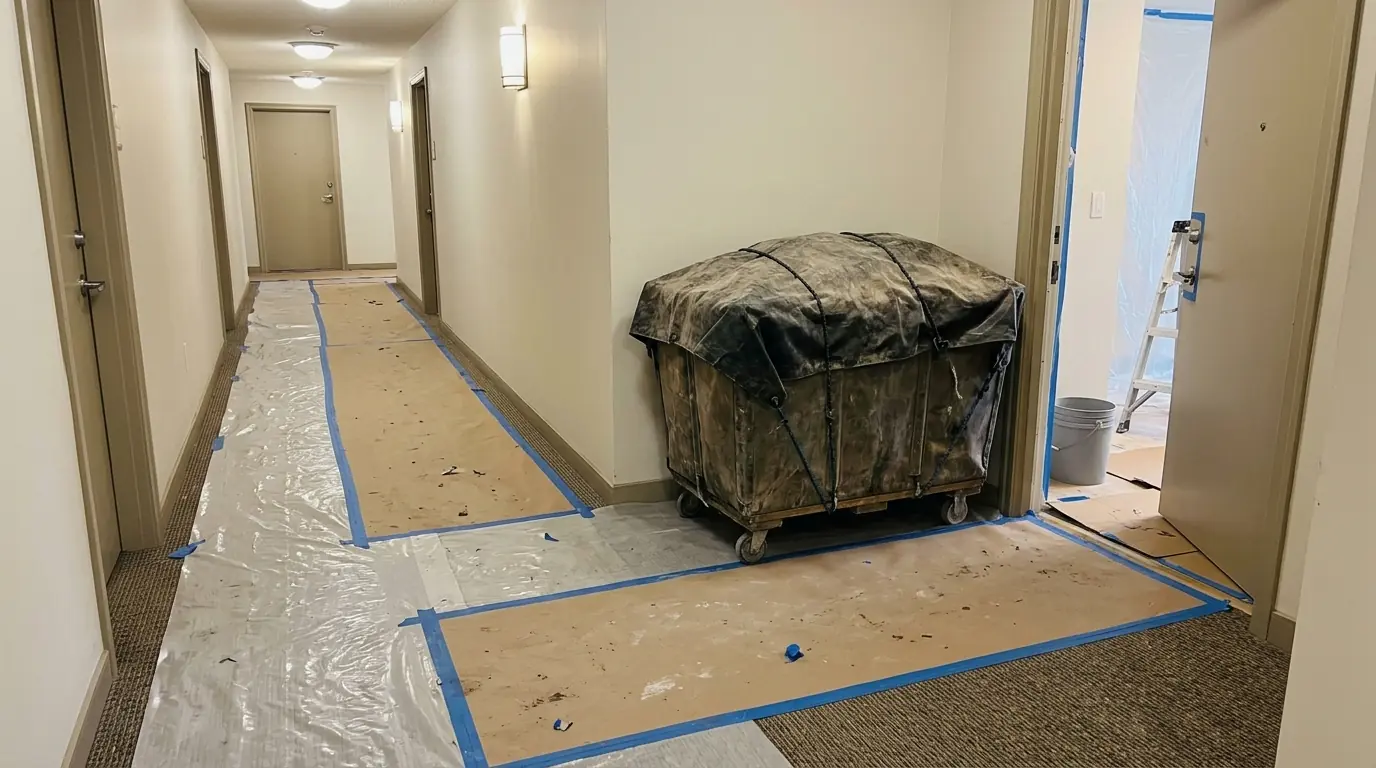
Condo leak work involves more people than a house leak, so the paperwork has to be readable by all of them. A crew doing condo leak restoration should map moisture in every affected unit, note which walls and ceilings were wet, photograph the source when it is accessible and keep daily drying readings. Separate notes for each unit help the association and each owner's insurer see exactly what was wet where.
Hidden moisture is common in stacked units, because water runs along slabs and down chases before it shows up as a stain. Hidden moisture detection with meters and thermal imaging finds wet drywall two rooms away from the obvious spot. Ask for copies of those readings and keep them with your claim file.
If the claim side feels confusing, insurance claim help means organizing photos, moisture logs and scope notes for your adjuster, not arguing coverage on your behalf. Once the drying is finished and the cost is clear, our restoration costs page gives a sense of typical ranges for the rebuild.
Keeping the peace with your neighbor
Unit-to-unit leaks can sour relationships fast, especially when the same neighbor's dishwasher has leaked before. It helps to keep conversations factual, share photos freely and let insurers and the association handle the fault question. Arguing in the hallway does not move the claim along and often makes access to the source unit harder.
Give your neighbor a written note with your insurer's name and claim number, and ask for theirs. Copy the building manager on anything you put in writing. A few calm, written notes now save weeks of back and forth later.
Common questions
Do I have to let the association into my unit to check a leak?
Most declarations give the association a right of access to inspect and repair common elements and to stop water from spreading, especially in an emergency. The details are in your declaration and bylaws. Allowing access quickly usually limits damage to your own unit as well.
My neighbor upstairs has no insurance. What now?
Report the loss to your own insurer and let them know the source unit appears to be uninsured. Your policy may respond to your covered damage, and your insurer and the association can look at their options from there. An attorney can explain what recovery from the neighbor might look like in your case.
Can repairs start before everyone agrees on who pays?
Drying usually has to start right away, because wet drywall and flooring can grow mold within a day or two. Most insurers expect you to take reasonable steps to prevent further damage. Keep careful records and photos, and hold off on major rebuild decisions until your adjuster has seen the damage or approved the plan.