Water, storm, fire and mold damage repaired in Miami homes
A soaked ceiling, a flooded floor or a smoke-stained kitchen gets worse every hour it sits, and in Miami's wet air, damp drywall can start growing mold within a day or two.
One crew stops the damage, dries the house with daily moisture readings, and rebuilds what had to come out. Call (786) 664-2643 at any hour and a person answers.
- 24/7Phones answered
- 4Damage types, one crew
- 60Areas we cover
- OwnCrews and equipment
- Water and flood
- Fire and smoke
- Storm and hurricane
- Mold and rebuild
If water, smoke or storm damage just hit your Miami home, stop the source if you safely can, turn off power to wet rooms, and take photos before anything gets moved. Then call (786) 664-2643. A crew lead answers at any hour, talks you through what to do right now, and sends a crew with extraction, drying and board-up equipment to start the work.
Who we are
A restoration crew that stays through the rebuild
Most damage calls start the same way: water on the floor, a stain spreading across the ceiling, or a smoke smell that will not leave. What happens over the next few days decides how much of the house has to come out. Water wicks up drywall and runs under cabinets, smoke residue keeps settling into paint and fabric, and in Miami's climate mold does not wait long.
New Kingston runs its own crews and its own equipment out of our Brickell office. The same team that pulls the water out also sets the air movers and dehumidifiers, takes the moisture readings, cleans or remediates, and then closes the walls, lays the floor and paints. You deal with one crew lead from the first walk-through to the final coat of paint, so you are not explaining your house to a new company halfway through the job.
Our drying follows the IICRC S500 standard for water damage restoration, and we write everything down as we go: dated photos, daily readings, what was removed and why. That record lets you, your adjuster and, if you live in a condo, your association look at the same facts. For a rough idea of a job before you call, look at our typical Miami pricing or try the restoration timeline estimator.
What we handle
Four kinds of damage, one crew
Most calls fall into one of these four groups, and plenty of jobs involve two at once: a hurricane that strips roof shingles and then soaks the ceiling, or a kitchen fire put out with a garden hose. We handle the whole chain, from the first emergency step to the finished room.
Water damage
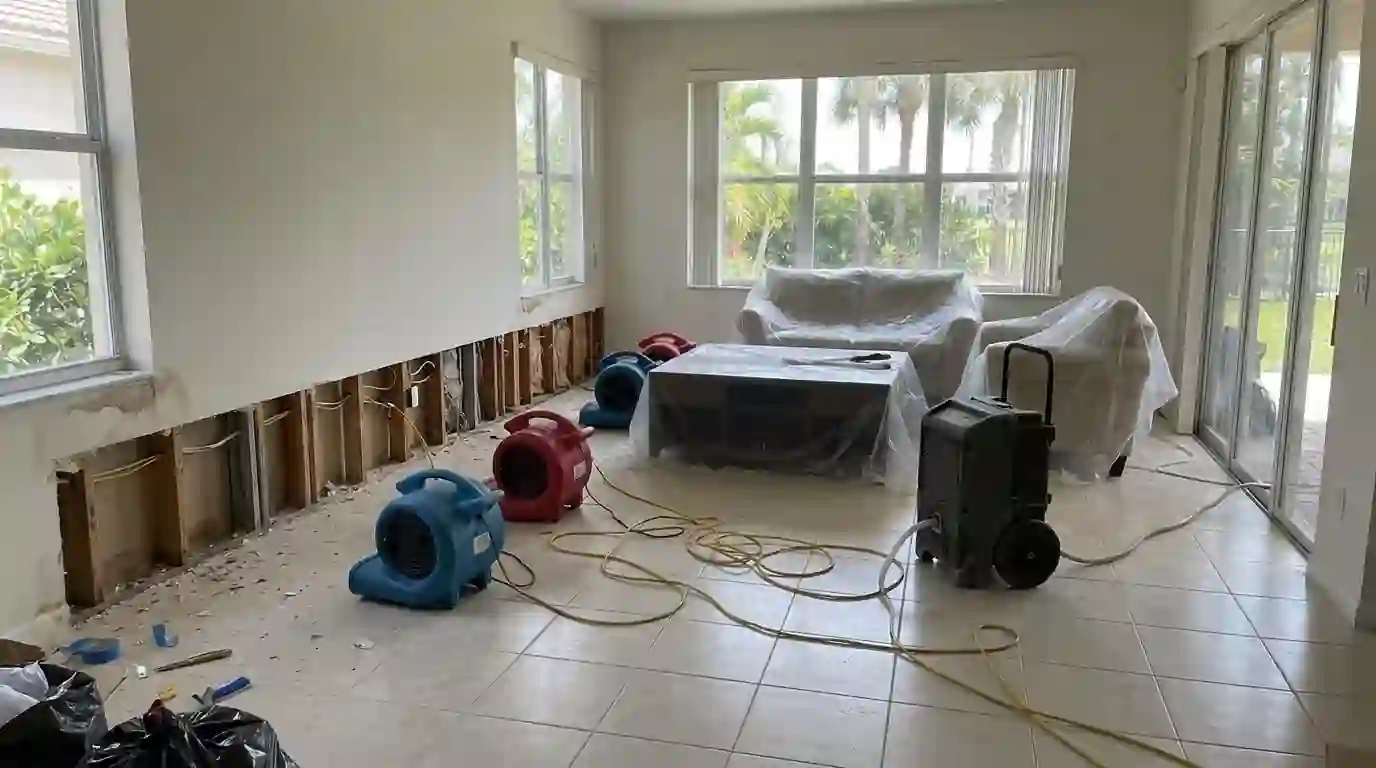
Burst supply lines, clogged AC drains, failed water heaters and slab leaks soak drywall, cabinets and flooring from the bottom up. We extract the water, open what has to come out, and dry the structure until every reading reaches dry goal.
Learn moreFire and smoke
Even a small kitchen fire leaves soot and odor through the whole house, plus the water used to put it out. We board up, clean or remove damaged surfaces, treat the odor at its source and rebuild.
Learn moreStorm and hurricane
Wind, rain and surge damage roofs, windows, soffits and everything underneath them. We tarp and board the openings first, then remove water and debris and rebuild once the house is sealed.
Learn moreMold
Mold grows where moisture stayed too long, often in AC closets, bathrooms and behind baseboards. We contain the area, remove the growth and fix the moisture behind it, while testing stays with an independent licensed assessor.
Learn moreEvery service
48 restoration services, grouped by what happened
Pick the one closest to your situation, or just call and describe it.
Water Damage
Storm & Hurricane
Fire & Smoke
Mold Remediation
Warning signs
Signs the damage is bigger than it looks
Water and smoke travel farther than you can see. If you notice any of these, the problem has probably spread past the spot you found first, and it is worth a call before it spreads further.
- A ceiling stain that keeps growingWater is pooling above the drywall, often from an AC drain pan, a roof leak or the unit upstairs, and the ceiling can sag or drop if it is left.
- Baseboards that swell or pull awayDrywall wicks water upward, so swollen or split baseboards usually mean the wall behind them is wet several inches up.
- A musty smell in one roomAn odor that will not clear often points to hidden moisture or mold behind a wall, under a sink or inside the AC closet.
- Loose or hollow-sounding tileWater under tile or along the slab can break the bond of the thinset, and it can be a sign of a leak below the floor.
- Paint that bubbles or peelsBlistered paint on a wall or ceiling means moisture is pushing through from behind, even when the surface feels dry to the touch.
- Soot film far from a small fireSmoke residue settles in closets, vents and rooms well away from the flame, and it gets harder to clean the longer it sits.
How it works
What happens after you call
The order matters. Each step protects the one after it, and each one is written down so you have a clear record of the job from start to finish.
- Your call is answeredA crew lead picks up at any hour, asks what happened and what you can see, and tells you what to do safely until the crew gets there. You also get a clear idea of what the crew will bring.
- We stop the sourceThe crew shuts off water, tarps the roof or boards up broken openings so no more damage gets in. Wet rooms are checked for electrical safety before anyone works in them.
- We document everythingBefore anything is removed, we photograph each room, map moisture with meters and a thermal camera, and note the cause of the damage. This is the record your adjuster will want.
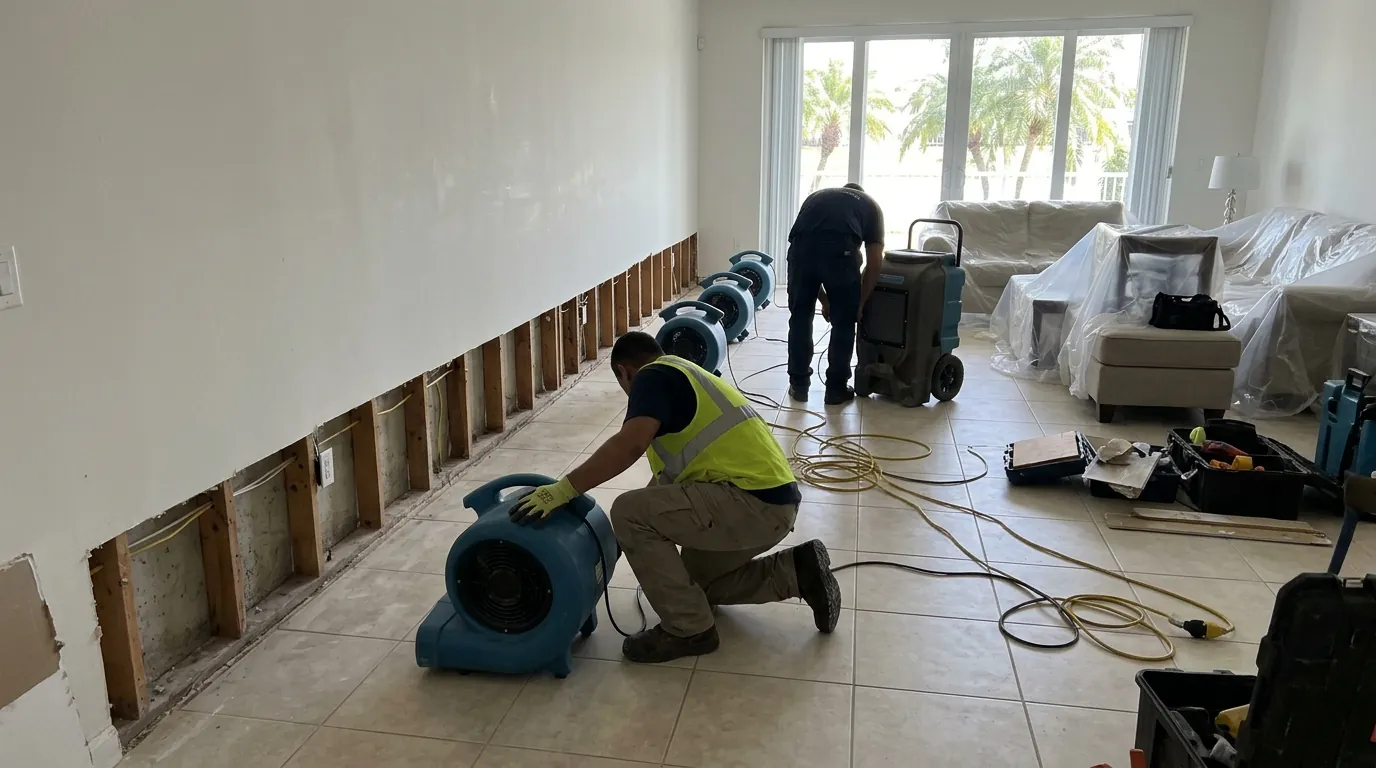
- We remove and dry, with daily readingsWet materials that cannot be saved come out, and air movers and dehumidifiers go in. Readings are taken and logged every day until each material reaches its dry goal.
- We clean or remediateSurfaces are cleaned and treated for the type of water or residue involved. Mold areas are contained and removed, and smoke odor is treated where it starts instead of being covered up.
- We rebuildOur crews replace drywall, flooring, cabinets and paint so the room is finished. You are not left with bare studs and a phone list of other contractors.
Miami houses
Why Miami houses take damage the way they do
Miami-Dade's housing is older than many people expect. FIU's Metropolitan Center reported in 2018 that about 70 percent of the county's housing was built before 1990, and more than a third was 50 or more years old. Older South Florida homes, commonly those built before about 1974, often have cast-iron drain lines that thin along the bottom, develop pinholes and leak into the soil under the slab.
The climate does the rest. Miami International Airport recorded 83.43 inches of rain in 2023, more than 16 inches above normal, and from late May to mid-October dew points stay above 70 degrees. When the outdoor air holds that much moisture, drywall and wood dry slowly, and a leak left alone over a long weekend can turn into a mold job. AC systems run most of the year here, and an algae-clogged condensate line can spill water into a ceiling or closet without much warning.
Then come the storms. Hurricane season runs June 1 through November 30, Miami-Dade's rainy season runs May 15 through October 15, and fall king tides can push saltwater into low streets on sunny days. Irma in 2017 drove roughly 3 to 5 feet of Biscayne Bay surge ashore from Homestead to Brickell, and the June 2024 rains dropped 15 to 20 inches across northern Miami-Dade and southern Broward in two days.
Insurance
Insurance: what we do and what we leave to you
We document the job so you have something solid to give your adjuster: dated photos of every room, daily moisture readings, a list of what was removed and why, and the cause of the damage as we found it. We do not interpret your policy or tell you what is covered. Florida law bars contractors from adjusting claims unless they hold a public adjuster license, and only your insurer decides coverage.
Report the loss quickly. Under Florida Statute 627.70132, notice of a new property claim must reach your insurer within 1 year of the date of loss, and a supplemental claim within 18 months. For a hurricane, the date of loss is the landfall date. Insurers have deadlines of their own: under the 2022 reform they must acknowledge your claim and begin investigating within 7 days, inspect within 30 days, and pay or deny within 60 days, with a possible extension during emergencies.
For policies issued on or after January 1, 2023, Florida law no longer allows you to assign post-loss benefits to a contractor, so we never ask you to sign an assignment of benefits. You stay in charge of your claim and deal with your insurer directly. Our insurance claim help covers how we organize the paperwork. Flood is a separate question: FEMA notes most homeowners policies do not cover flood damage, so check whether you carry a flood policy.
Why homeowners call us
What you can count on from our crews
No big promises here, just the way we run every job, from a single soaked closet to a whole house after a storm.
Our own crews and equipment
The people who show up work for us and bring our own extraction units, air movers and dehumidifiers. The same crew lead stays with your job from the first day to the last.
Readings, not guesses
We measure moisture in walls, floors and cabinets every day and record the numbers. Equipment comes out when the readings say the materials are dry, not when a calendar says so.
A clear record for your file
Photos, moisture logs and scope notes are organized so you can hand them to your adjuster. You get copies of everything we write down about your home.
We finish the job
Drying and cleaning are only half the work. We put back the drywall, floors, cabinets and paint, so you are not left searching for a second contractor.
Where we work
Where our crews work
We work in Miami's neighborhoods, from Morningside and Belle Meade down to Silver Bluff and Brickell Key, and across the rest of Miami-Dade County, from Aventura to Homestead. Crews also cover Broward County, from Hallandale Beach up to Deerfield Beach, and south Palm Beach County around Boca Raton.
Miami
Nearby cities
Office and phone
- Phone
- (786) 664-2643
- Hours
- Open 24 hours, 7 days a week
- Office
- 1450 Brickell Ave, Miami, FL 33131
- Coverage
- Miami-Dade, Broward and Boca Raton
Restoration Blog
Read before the next storm
What is a flood cut, and why do crews cut drywall at a set height?
A flood cut is a straight line cut through drywall above the waterline. Why crews make one, how they pick the height and what happens to the wall next.
Read itRestoration BlogAging cast-iron drains and sewage backups in older Miami homes
Why aging cast-iron drains in older Miami homes crack, scale and back up, the warning signs to watch for, and what to do when sewage comes up a drain.
Read itRestoration BlogWhy mold starts so fast after a leak in Miami
Miami humidity gives mold a head start after any leak. Learn the 24 to 48 hour drying window, where mold hides first and how to keep it from starting.
Read itQuestions
Questions Miami homeowners ask first
What should I turn off and move before the restoration crew gets to my house?
Shut off the water at the fixture or the main if you can, and turn off breakers for wet rooms without standing in water to do it. Move rugs, electronics and photos off wet floors, and take wide and close-up photos of every affected room. Do not run a household vacuum on standing water or turn on ceiling fixtures that got wet.
What should I ask a restoration company before the work starts?
Ask who will actually do the work, whether they take daily moisture readings and share them with you, and whether they rebuild or only dry out. Ask for a written scope before any demolition starts. In Florida, a contractor should never ask you to sign over your insurance benefits, and a contractor cannot adjust your claim without a public adjuster license.
Can the same company test for mold and remove it in Florida?
No. Florida licenses mold assessors and mold remediators separately, and the law bars a company from remediating a home it assessed within the past 12 months, or assessing one it remediated. We do the remediation. An independent licensed mold assessor that you hire does the testing and the clearance check after we finish.
Do I need to be home when the crew arrives?
Someone needs to let the crew in and walk through the damage with the crew lead on the first visit. After that, many homeowners arrange access through a lockbox, a neighbor or the building manager while the drying equipment runs. In a condo, let the front desk or association know a crew is coming so elevator and parking access are sorted out ahead of time.
How will I know when my house is actually dry?
Not by touch. We compare readings in the wet areas with readings from dry areas of the same material elsewhere in your home, and we log them every day. When the wet areas match the dry ones, drying is done and the equipment comes out. You get the full log for your records.
Is it worth calling in the middle of the night, or can it wait until morning?
Call. Our phone is answered around the clock, every day of the year, holidays and storm weeks included. The crew lead can talk you through shutting off the water, protecting your belongings and staying safe tonight, and in Miami's humidity a few extra hours of standing water can mean more material has to come out.
Water, smoke or storm damage right now?
Call (786) 664-2643. A person answers at any hour, asks what happened, and tells you what to do while the crew gets moving.