Skip to content
Water, fire, storm and mold calls answered 24/7 across Miami-Dade and Broward(786) 664-2643
New KingstonWater & Restoration · Miami(786) 664-2643Answered 24/7
Stains, sags and drips

Ceiling leak damage repair in Miami

A ceiling stain is the last thing a leak shows you: by the time the brown ring appears, water has usually soaked the insulation above, spread along the drywall and found the lowest point to collect.

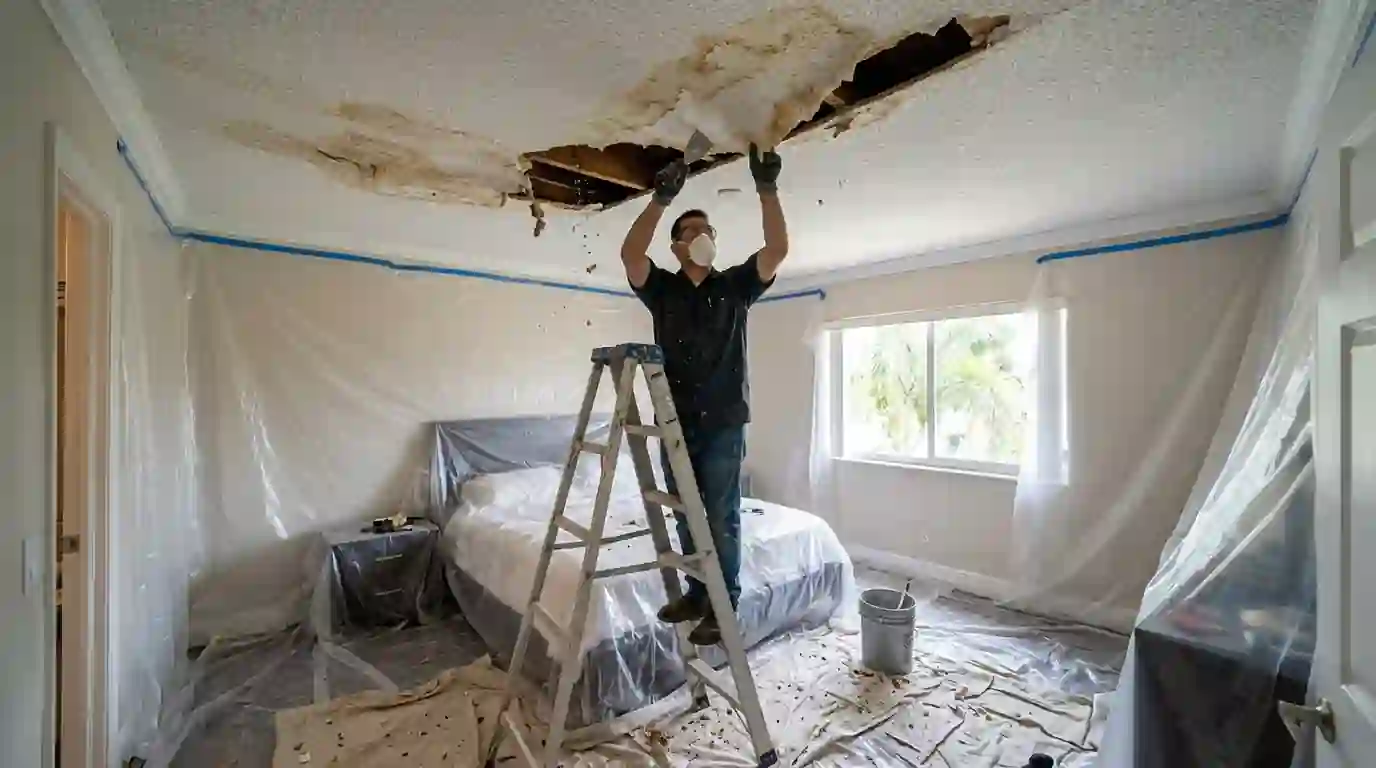
Technician removing a sagging water-stained section of popcorn ceiling in a Miami home bedroom with plastic sheeting below
Quick answer

If the ceiling is sagging, keep people out of the room and do not press on it, because wet drywall can fall. Put a bucket under any drip and switch off light circuits nearby. A crew removes the saturated drywall and insulation, dries the framing and the space above, then rebuilds and paints once the source is fixed.

Ceiling damage in Miami comes from three main places: the roof during a summer downpour or a storm, an attic air handler with a clogged condensate drain, or plumbing running through the ceiling of a two-story home or the unit above in a condo.

Wherever the water came from, the ceiling repair follows the same path. Stop the source, open what is soaked, dry the space above and rebuild the drywall and paint. Repainting a stain without drying behind it is how the same ring comes back after the next rain.
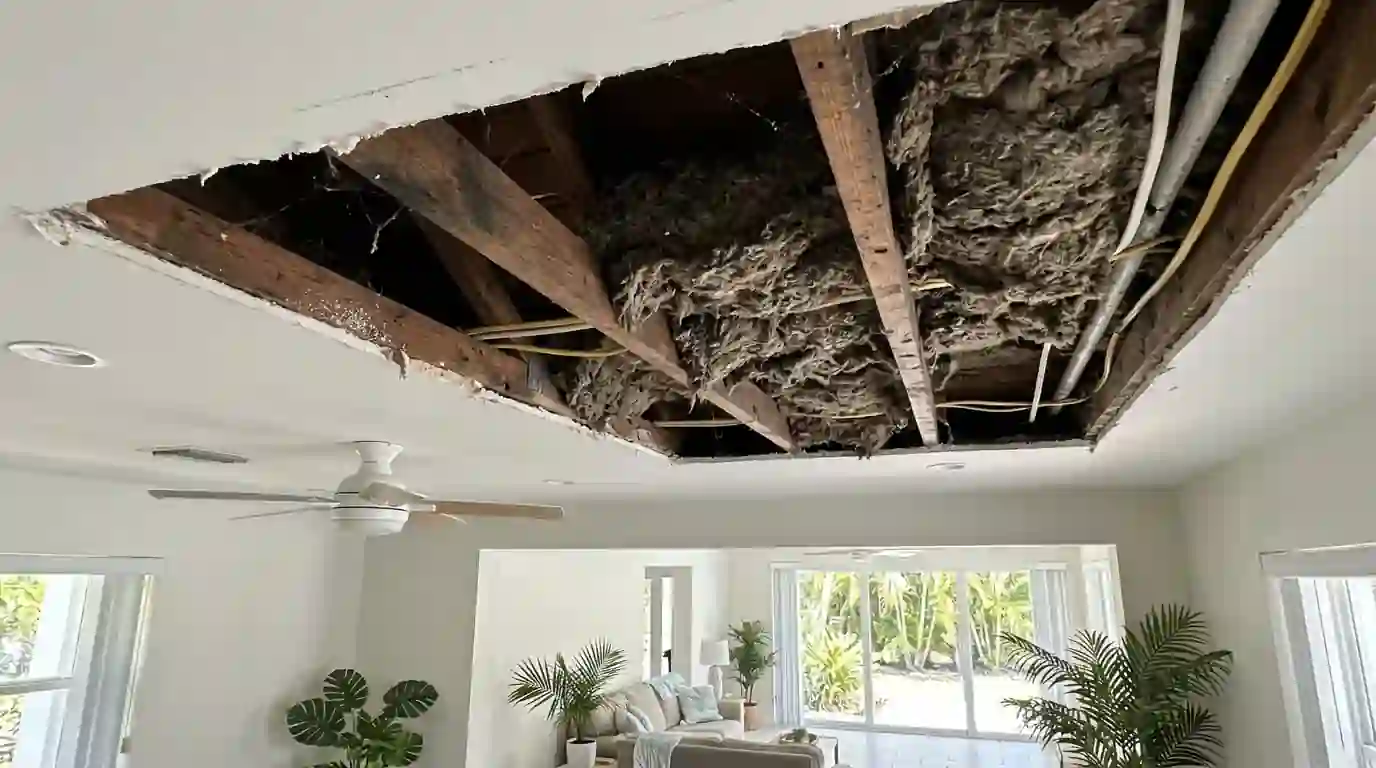
Open ceiling cavity showing wet blown insulation and wood joists above a South Florida living room

Where ceiling water comes from in Miami homes

Roof leaks show up during the rainy season, which Miami-Dade lists as May 15 through October 15, and after tropical storms. Water enters at flashing, vents or damaged tiles and spreads over the drywall before dripping through, and the interior side of that is covered on our roof leak water damage page.

Attic air handlers are the other big source. When the condensate drain clogs, the pan overflows straight onto the ceiling below, and because the AC runs most of the year here, the leak can go on for weeks. Our AC leak page covers that cause.

In two-story homes and condos, plumbing between floors is the third. A slow drain leak from a tub or shower upstairs often shows as a stain that only grows after someone bathes.

When a sagging ceiling needs to come down now

Wet drywall is heavy and weak. A ceiling that bellies down can hold for hours, then drop all at once, along with soaked insulation. If you see a sag, clear the room, cover the floor and keep children and pets out.

Do not poke the bulge to let water out unless you are sure the area under it is clear, and never stand directly under it. If water is near a light or fan, switch that circuit off at the breaker. When the crew arrives, they relieve the water in a controlled way and remove the failed section.

Signs to act on

When to call about ceiling leak damage repair

  • A brown ring that keeps growingA stain with a darker edge that spreads after each rain or AC cycle means the leak is active.
  • A belly in the drywallA sag or bulge shows water has pooled on top of the drywall and the board is losing strength.
  • Drips at a light or fanWater uses fixture holes as a drain, so drips there often mean a lot of water sits above.
  • Popped screw headsSmall round bumps in a row show drywall swelling and pulling away from the joists.
  • Peeling paint and texturePopcorn or knockdown texture that flakes or falls off in one area points to moisture behind it.
  • Cracks along the tape jointsFresh cracks along seams can mean the board on either side has gotten wet and moved.

Drying the space above, not just the drywall

The ceiling board is only one layer. Above it, insulation in an attic can stay wet long after the drywall dries, and wood trusses or joists can hold water too. Leaving wet insulation in place feeds mold above a ceiling that looks repaired.

The crew removes soaked insulation, reads the framing and dries the attic or ceiling cavity with airflow and dehumidifiers. In the heat of a Miami attic, moisture also condenses on the underside of the roof deck, so the drying plan reaches above the ceiling joists, not just below them.

If growth has already started on the decking or trusses, the job moves to attic mold removal before rebuilding.

Matching texture and paint

Once the framing is dry and the source is fixed, new drywall goes in, gets taped and finished, and the texture is matched to the rest of the ceiling. Popcorn, knockdown and smooth finishes each need their own approach to blend.

Water stains bleed through regular paint, so any surrounding area with a stain gets a stain-blocking primer first. Interior painting then carries the finish to a natural break line, like the edge of the room, so the patch does not show as a different shade.

  • Popcorn texture: often sprayed to match, or removed across the room for a clean finish
  • Knockdown: sprayed and flattened to match the pattern
  • Smooth: skim coated and sanded to a flat finish

How the job runs

From your call to a finished room

  1. Make the room safeThe crew checks for sagging, switches off nearby fixtures and protects the floor and furniture.
  2. Trace the waterMeters and thermal imaging outline how far the wet area spreads across the ceiling and into walls.
  3. Remove wet drywall and insulationSaturated board and insulation come out in clean sections and are bagged.
  4. Dry the cavity aboveAirflow and dehumidifiers dry joists, trusses and the attic space with readings each visit.
  5. Confirm the source is fixedThe roofer, plumber or HVAC technician repairs the cause before the ceiling is closed.
  6. Rebuild and finishNew drywall is hung, taped, textured, primed and painted to match the room.

Questions

Ceiling Leak Damage Repair questions

Can I just paint over a dry water stain on my ceiling?

Only if the source is fixed and readings show the drywall and space above are dry. Even then, use a stain-blocking primer first, since ordinary paint lets the brown ring bleed through. If the board is soft or sagged, it needs replacing, not paint.

Should I poke a hole in a bulging ceiling to drain it?

Only as a last resort, with a bucket in place, the area under it clear and no light fixture nearby. A small hole at the lowest point can relieve the weight. If the bulge is large, keep out of the room and wait for the crew.

How do I know if the stain is from the roof or the AC?

A stain that grows after rain points to the roof. One that grows on dry days, near where the air handler sits in the attic, points to the AC drain. A crew can confirm with readings and by checking the attic above the stain.

Does wet attic insulation always need to be replaced?

Blown insulation that got soaked usually packs down and holds water, so it is replaced. Insulation that only got damp at the edges may dry. Leaving wet insulation over a ceiling invites mold and odor.

Will the new ceiling patch show?

A well-done patch should not be obvious. Texture is matched, the area is primed, and paint is carried to a corner or edge so there is no visible line. Very old or yellowed ceilings sometimes need the whole room painted for an even look.

Water, smoke or storm damage right now?

Call (786) 664-2643. A person answers at any hour, asks what happened, and tells you what to do while the crew gets moving.

Call (786) 664-2643 · 24/7