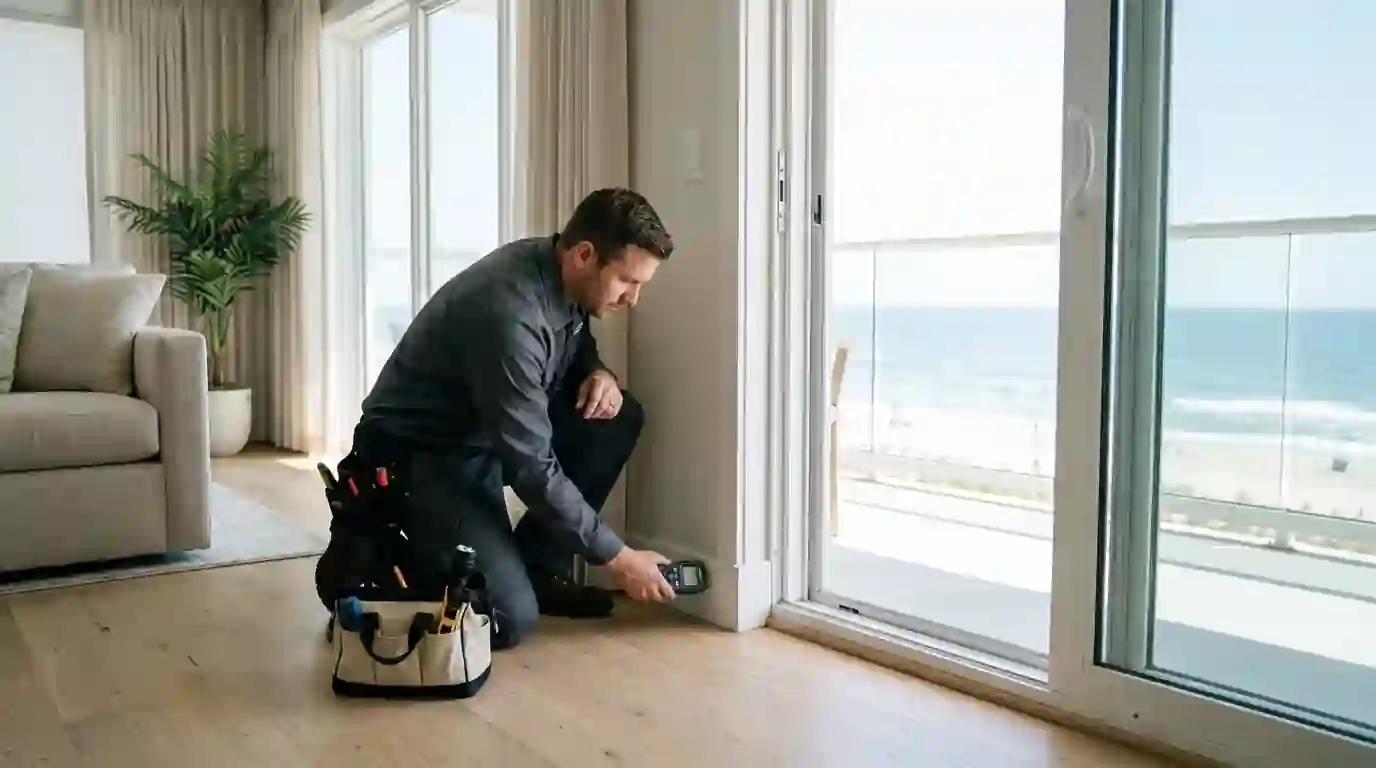
If water gets into your Surfside condo or house, stop the source if you can, photograph the damage and tell your association if you live in a condo building. The crew finds hidden moisture with meters and thermal imaging, removes wet materials, dries to a measured goal, and removes any mold growth under containment before rebuilding.
The town sits on the barrier island between Miami Beach's North Beach and Bal Harbour, along Collins and Harding avenues. Most bay-side lots were subdivided between 1923 and 1925, so many houses are old, and multistory condo buildings line Collins Avenue on the ocean side. About three in four homes are owner-occupied.
In Surfside, water damage most often means a balcony door that leaks in sideways rain, a supply line that fails in a unit above, or a ground-floor room that takes water during a storm or a high tide. Each one leaves moisture in drywall and framing, and in this climate mold follows if it is not dried.
Milestone inspections and what they cover
On June 24, 2021, Champlain Towers South at 8777 Collins Avenue partially collapsed, and 98 people died. In 2022 Florida passed a law requiring milestone inspections of condo buildings three stories or higher, starting 30 years after first occupancy and repeating every 10 years, along with structural reserve studies.
Those inspections are done by a Florida-licensed architect or engineer the association hires, and structural repairs are the association's work. Our part is different: drying and rebuilding inside units and common areas after leaks, and working around the association's repair schedule when it touches your unit.
Leaks that move between condo units
In a multistory building, water from a failed supply line, a washer hose or an AC drain runs down to the unit below and along the slab to the unit next door. Ceiling stains below are often the first sign. The crew traces the path with moisture meters, opens only what is wet and notes which damage sits in each unit and which in common areas.
That record helps the owners and the association sort out responsibility with their insurers. Our page on condo leak restoration covers the stacked-unit process in more depth.
Salt air, sliders and wind-driven rain
Oceanfront exposure wears on sliding door tracks, window seals and balcony thresholds. In a strong squall, rain blows in under the slider and soaks the subfloor, baseboard and the bottom of nearby walls. Because it happens in short bursts, the damage often builds up over several storms before anyone sees it.
Salt and concrete spalling on balconies are matters for the association and its engineer. Inside the unit, the crew dries the floor and walls and replaces what cannot be dried.