Skip to content
Water, fire, storm and mold calls answered 24/7 across Miami-Dade and Broward(786) 664-2643
New KingstonWater & Restoration · Miami(786) 664-2643Answered 24/7
Tile, plank and wood

Flooring replacement after water damage in Miami

Tiles that sound hollow when you tap them, planks lifting at the seams, or a living room floor half torn out after a leak: the slab underneath has dried, and now the floor has to go back.

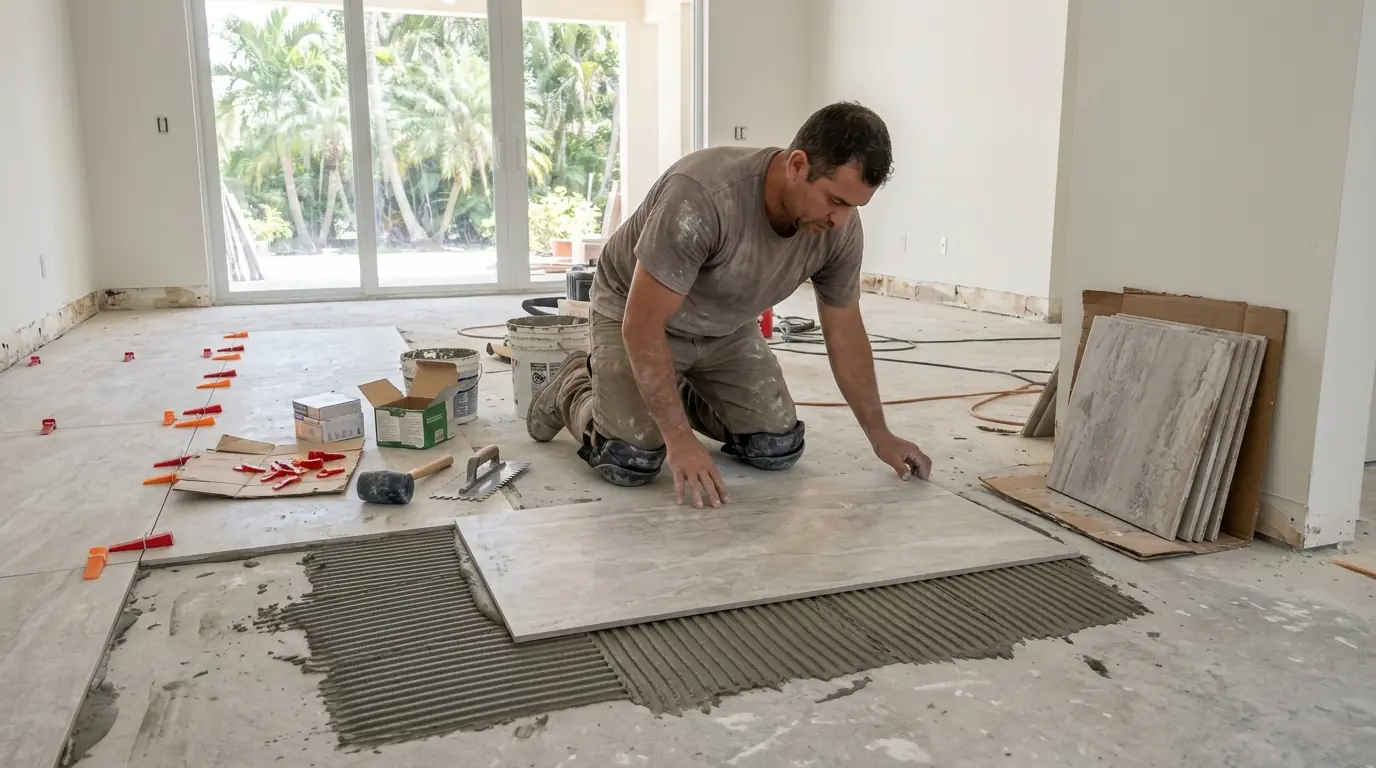
Installer setting large-format porcelain tile on fresh thinset across a Miami living room slab, saved original tile resting nearby for matching
Quick answer

Replacement starts with a slab moisture test, because flooring adhesives and underlayments fail over damp concrete. Loose or cracked tile and swollen plank are removed, old thinset is ground flat, and the new floor goes down to match the old one in size, color and pattern. When your exact tile is discontinued, you decide between a close match with a transition and replacing a continuous area.

In a Miami home, the floor usually sits directly on a concrete slab. That is good news during a leak, because concrete does not rot. It also means water spreads under tile, plank and laminate, wets the thinset or underlayment, and keeps the slab damp long after the surface looks fine.

This page covers replacing floors removed or ruined by water, sewage, fire or storm damage. It does not cover style updates. The goal is a floor that matches what you had, laid on a slab that is truly dry, with transitions that look planned rather than patched.
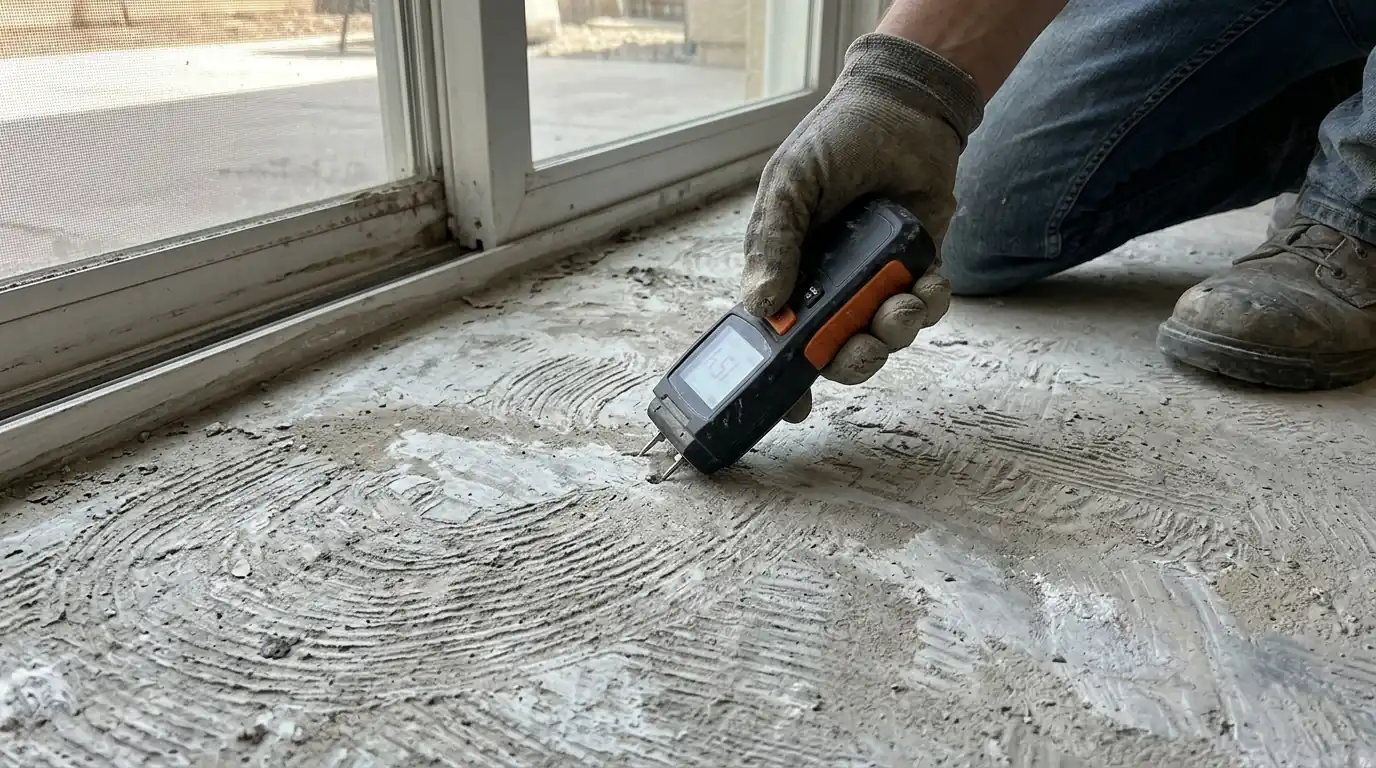
Pin-type moisture meter reading taken on a bare concrete slab after old tile and thinset were ground away near a sliding door

Testing the slab before anything is laid

Concrete gives up water slowly. Restoration guidelines based on IICRC S500 treat dense materials like concrete and hardwood as specialty drying, because they hold moisture deep inside. A slab can feel dry while still reading too wet for tile adhesive or a click-lock floor.

The crew tests the slab in several spots, including along walls and near the leak source, and compares the numbers with an unaffected room. Laying flooring before those readings settle leads to loose tiles, mildew under plank and returning odor.

Finding a match for tile that is no longer made

Many Miami homes have one porcelain or ceramic tile running through the living room, dining room, kitchen and hallway. When a leak ruins part of it, the original line is often discontinued, and even a current tile from the same maker may differ in size, shade or edge.

A saved tile is the starting sample. From there, the realistic options are:

  • A close match laid up to a natural break, such as a doorway or threshold, with a clean transition strip
  • Pulling matching tiles from a closet or under a built-in and filling those spots with the close match
  • Replacing the floor across the whole connected area so everything matches
  • Using a contrasting border or inlay to make the change look deliberate

Tile, vinyl plank, laminate and wood each fail differently

Tile on thinset usually survives clean water if the bond holds, so not every tile in a wet room has to come up. Sound tiles stay. Hollow, cracked or loose ones are removed, the old thinset is ground off, and new tiles are set to the same grout width and height.

Vinyl plank resists water on top, but water travels under it and gets trapped against the slab. Laminate has a fiberboard core that swells and cannot be dried back flat. Engineered and solid wood sometimes recovers with drying, though boards that cup badly or stain dark are replaced. After sewage or flood water, porous flooring and underlayment come out regardless.

Signs to act on

When to call about flooring replacement

  • Hollow sound under tileTapping with a coin or screwdriver handle gives a dull, hollow note where the bond to the slab has let go.
  • Cupped or peaked plank edgesLaminate or vinyl plank seams rise or dip as the core swells from water underneath.
  • Grout darkening in a patternGrout lines stay dark in one area long after mopping, showing moisture moving up from below.
  • Cracked tiles along one lineA row of tiles cracks in a straight path, often following a slab crack or a pipe trench.
  • Wood floor crowning or gappingSolid or engineered wood boards bulge in the middle or open gaps between rows as moisture changes.
  • Musty smell at floor levelOdor is strongest when you kneel down, a common sign of damp padding or underlayment under the floor.

Condo floors and the sound rules above someone's ceiling

In a condo, your floor is the ceiling of the unit below. Many associations require a specific sound-control underlayment under tile or hard flooring and want proof of the product before work starts. Check the rules before choosing a replacement.

Work hours matter too. Grinding thinset and cutting tile are loud, and buildings often restrict those tasks to weekday daytime hours. If your floor got wet from a unit above, the condo leak restoration page explains how responsibility usually splits between owners and the association.

Moving furniture, baseboards and transitions

Baseboards come off before tile or plank goes down and go back afterward, which also hides the expansion gap that floating floors need. Door casings are undercut so new flooring slides beneath them instead of being scribed around them.

Furniture and large appliances are moved by the crew and set back when the floor has cured. New Kingston plans transitions at doorways and room edges, so the new floor reads as one finished surface. The full rebuild order is on the reconstruction page.

How the job runs

From your call to a finished room

  1. Tap and map the floorEvery tile in the area is tapped and marked, and plank seams are checked, so only failed sections come up.
  2. Test the slabMoisture readings at several spots confirm the concrete is dry enough for adhesive or underlayment.
  3. Remove and grindDamaged flooring is lifted and old thinset or adhesive is ground smooth so the new floor sits level.
  4. Match or choose materialsA saved sample is matched, or you pick between transition and full-area options before anything is ordered.
  5. Set the new floorTile is set and grouted, or plank is laid over the correct underlayment, at the same height as the floor that stayed.
  6. Trim and resetBaseboards, transitions and door casings go back, and furniture returns once grout or adhesive has cured.

Questions

Flooring Replacement questions

Can a few tiles be replaced without redoing the whole floor?

Yes, when the surrounding tiles are still stuck firmly to the slab and a matching tile exists. Each loose tile is cut out, the thinset ground flat and a new tile set at the same height. Grout color is matched with small test batches.

Why does new tile look slightly different from the old tile?

Tile is made in batches, and color shifts slightly from one run to the next even within the same line. Old tile has also aged under foot traffic and sunlight. A transition at a doorway hides that difference far better than a patch in the middle of a room.

Is vinyl plank a good choice for a Miami home after water damage?

It holds up well to spills and humidity on the surface, which is why it is popular here. It does not stop water already under it from trapping against the slab. Over a slab with a history of leaks, the underlayment choice matters as much as the plank.

How long after drying can new flooring be installed?

It depends on slab readings, not the calendar. A small clean-water leak may test dry within days, while a flooded slab can take noticeably longer in humid months. The crew installs only when readings reach the dry reference.

Do I need to empty the room completely?

Small items, valuables and anything fragile should come out. The crew moves furniture and appliances. If the job is large, a contents pack-out keeps belongings clean and stored while the floor cures.

Water, smoke or storm damage right now?

Call (786) 664-2643. A person answers at any hour, asks what happened, and tells you what to do while the crew gets moving.

Call (786) 664-2643 · 24/7