Skip to content
Water, fire, storm and mold calls answered 24/7 across Miami-Dade and Broward(786) 664-2643
New KingstonWater & Restoration · Miami(786) 664-2643Answered 24/7
Rebuild after the loss

Home reconstruction after damage in Miami

Once the wet drywall, ruined cabinets and soaked flooring are gone, you are left with bare block walls, open studs and a slab, and the house still has to become your home again.

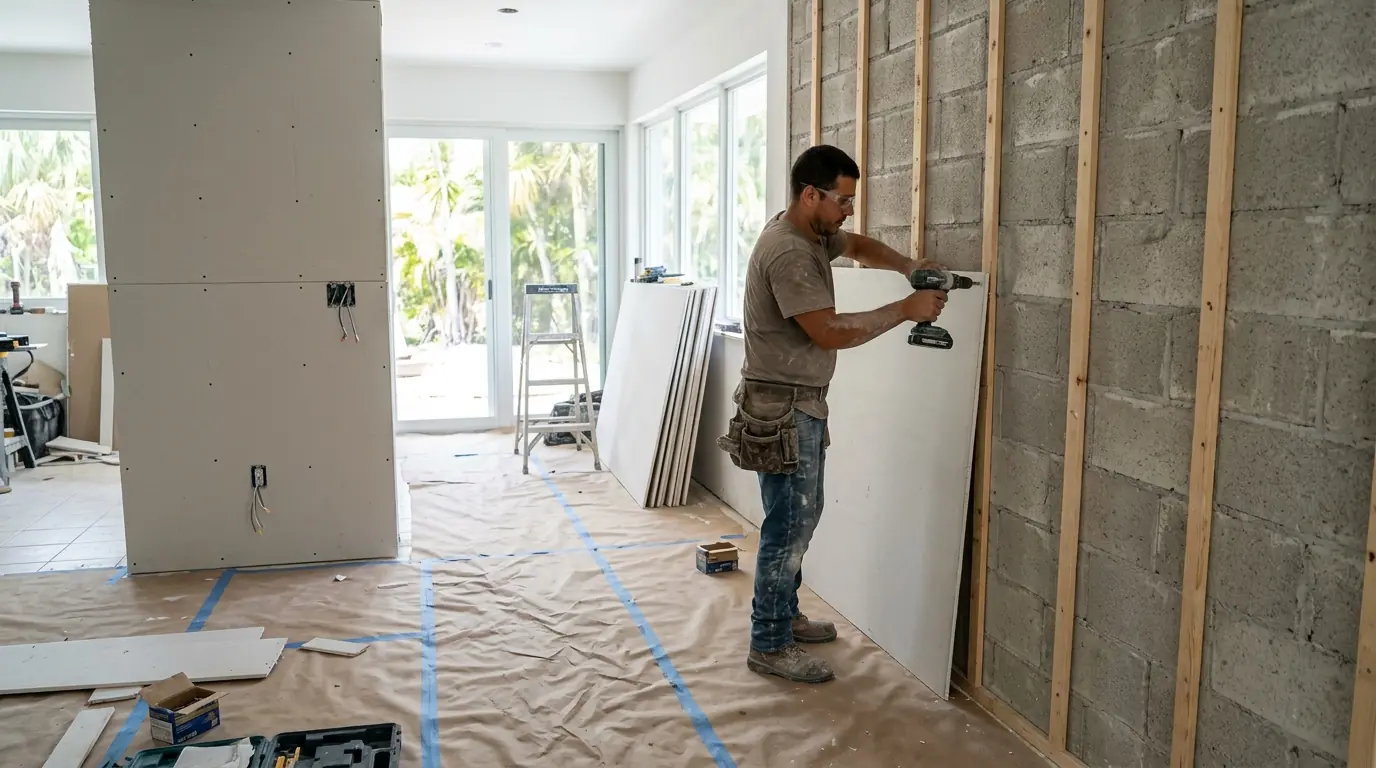
Crew member hanging new drywall on furring strips over a concrete block wall in a Miami living room, tile floor covered with protective paper
Quick answer

Rebuilding starts only after drying is confirmed with moisture readings, and after an independent mold assessor clears the area if mold was involved. The crew then works in a fixed order: framing and blocking, insulation, drywall, trim and doors, cabinets and counters, flooring, then paint. Small one-room jobs move quickly; whole-floor rebuilds take longer, mostly because of material orders and condo or permit scheduling.

Reconstruction is the second half of a restoration job. Mitigation removes what water, fire, smoke or mold ruined and dries what can be saved. Reconstruction puts the house back together: framing, insulation, drywall, doors, trim, cabinets, tile and paint, matched to what was there before the loss.

This is not a remodel. The aim is to return each room to its pre-loss condition, working from the scope your adjuster reviewed. When the New Kingston crew that opened the walls also closes them, nothing gets lost between the two jobs.
Close-up of a moisture meter pressed against new wood framing beside open studs, checked before insulation and drywall go back in

What has to be true before rebuilding starts

Closing a wall over damp framing grows mold where nobody can see it. Before new board goes up, studs, block and slab are checked with meters against readings from unaffected rooms, and those numbers go in the job file next to the photos.

Miami makes this step slower than people expect. NWS Miami notes that dew points typically stay above 70°F from late May to mid-October, so the air itself carries a heavy moisture load. Equipment from the structural drying phase keeps running until readings hold steady, not until a set number of days has passed.

If mold was part of the loss, Florida law keeps the mold assessor and the remediator separate on the same job. An independent licensed assessor you hire checks the area after remediation, and rebuilding waits for that clearance.

Building back inside concrete block houses

Most Miami houses sit on a concrete slab with concrete block exterior walls. Inside, drywall is fastened to furring strips, thin wood or metal strips attached to the block. When water wicks up the wall, those strips often rot or rust along with the board, and they have to be replaced before new drywall can hang straight.

Older homes bring surprises. FIU's Metropolitan Center reported that about 70% of Miami-Dade's housing was built before 1990, and many of those houses carry plaster or odd wall thicknesses. New materials are shimmed to sit flush with what stayed, so the repair line disappears.

Signs to act on

When to call about reconstruction after damage

  • Walls cut open at flood-cut heightDrywall was cut two or four feet up the wall during drying, and the gap now runs around the whole room.
  • Cabinets pulled for dryingBase cabinets came out so the wall and slab behind them could dry, and they cannot simply be screwed back in place.
  • Charred framing removedFire-damaged studs or ceiling joists were cut out and need new lumber, blocking and fasteners before anything else goes up.
  • Open cavities after mold workRemediation removed drywall and insulation, and the independent assessor's clearance is in your hands.
  • Floor broken up by tear-outPart of the tile or plank is gone and the remaining floor no longer runs continuously through the rooms.
  • Plywood still over an openingA storm-broken window or door is boarded and the drywall, trim and floor around it took rain.

Matching finishes so the repair does not show

Both the insurance scope and you expect the rebuilt room to look like the original. That means matching baseboard and casing profiles, door styles, wall texture (knockdown, orange peel or smooth), paint sheen and tile. Offcuts saved during tear-out become the samples the crew matches against.

Tile is the hardest piece in Miami. Many homes have one porcelain tile running through the entire first floor, and the exact line is often discontinued. When no match exists, you see the options before anything is ordered: a close match with a transition at a doorway, borrowing tiles from a closet, or replacing the floor across a continuous area. The flooring replacement page walks through that decision, and cabinets follow the kitchen rebuild sequence.

Code, permits and condo rules in Miami-Dade and Broward

Miami-Dade and Broward sit in the Florida Building Code's High-Velocity Hurricane Zone, where many requirements are stricter than in the rest of the state. A broken window or exterior door, for example, has to be replaced with a product tested to the Miami-Dade impact protocols. The scope flags items like this early so they do not hold up the interior work.

Whether an item needs a permit depends on what is replaced and which municipality you are in. Structural framing, plumbing and electrical changes are the usual candidates, and the plan lists them so you know which stages pause for inspection.

Condos add another layer. Associations set work hours, elevator reservations and noise rules, and the condo documents decide where the unit ends and the common elements begin. Waiting on cabinets, special-order tile and inspections stretches a schedule more than the labor does; the restoration time estimator gives a rough timeline.

How the job runs

From your call to a finished room

  1. Walkthrough with the dry logThe crew lead walks the rooms with you, reviews the final moisture readings and checks the scope against what was removed.
  2. Pick and order materialsTile, cabinets, doors and trim are matched or chosen, and long-lead items are ordered first.
  3. Framing, furring and blockingDamaged studs and furring strips are replaced and blocking goes in for cabinets and fixtures before walls close.
  4. Insulation and drywallInsulation returns, then drywall is hung, taped, finished and textured to blend with the room.
  5. Doors, trim, cabinets and floorsDoors, baseboard and casing are set, cabinets are leveled and anchored, and flooring goes down.
  6. Paint and punch listWalls get primer and paint, fixtures go back on, and you walk the finished space with a punch list before the job closes.

Questions

Reconstruction After Damage questions

Can I use one company for drying and a different one for the rebuild?

Yes, you choose who rebuilds your home. Keeping both phases with one crew means the person closing the walls already has the moisture logs and tear-out photos. If you go elsewhere, ask for those records so the next contractor starts with them.

Can I upgrade materials while the walls are open?

You can. Your adjuster decides what the claim covers, so upgrades are written as separate lines that you pay for directly, which keeps the claim paperwork clean.

Do I need to move out while the house is rebuilt?

Often not, if the work is limited to a room or two and you still have a working kitchen and bathroom. Whole-floor rebuilds and fire jobs with heavy odor usually mean staying elsewhere for a while.

What happens if more damage turns up halfway through?

It is photographed, measured and added to the job file that day, and you see it before work continues there. Florida allows a supplemental claim within 18 months of the date of loss, so pass it to your adjuster.

Will the new walls and ceilings match the old texture?

Texture is matched by hand on site, using a test patch on scrap board first. Knockdown and orange peel blend well once the whole wall is painted. Hand-troweled plaster takes more work, and you see a sample first.

Water, smoke or storm damage right now?

Call (786) 664-2643. A person answers at any hour, asks what happened, and tells you what to do while the crew gets moving.

Call (786) 664-2643 · 24/7