Skip to content
Water, fire, storm and mold calls answered 24/7 across Miami-Dade and Broward(786) 664-2643
New KingstonWater & Restoration · Miami(786) 664-2643Answered 24/7
Unit to unit leaks

Condo leak restoration in Miami

In a Miami high-rise, one leak rarely stays in one unit: water from a failed supply line or AC drain upstairs can run down through ceilings, walls and light fixtures and reach two or three floors below.

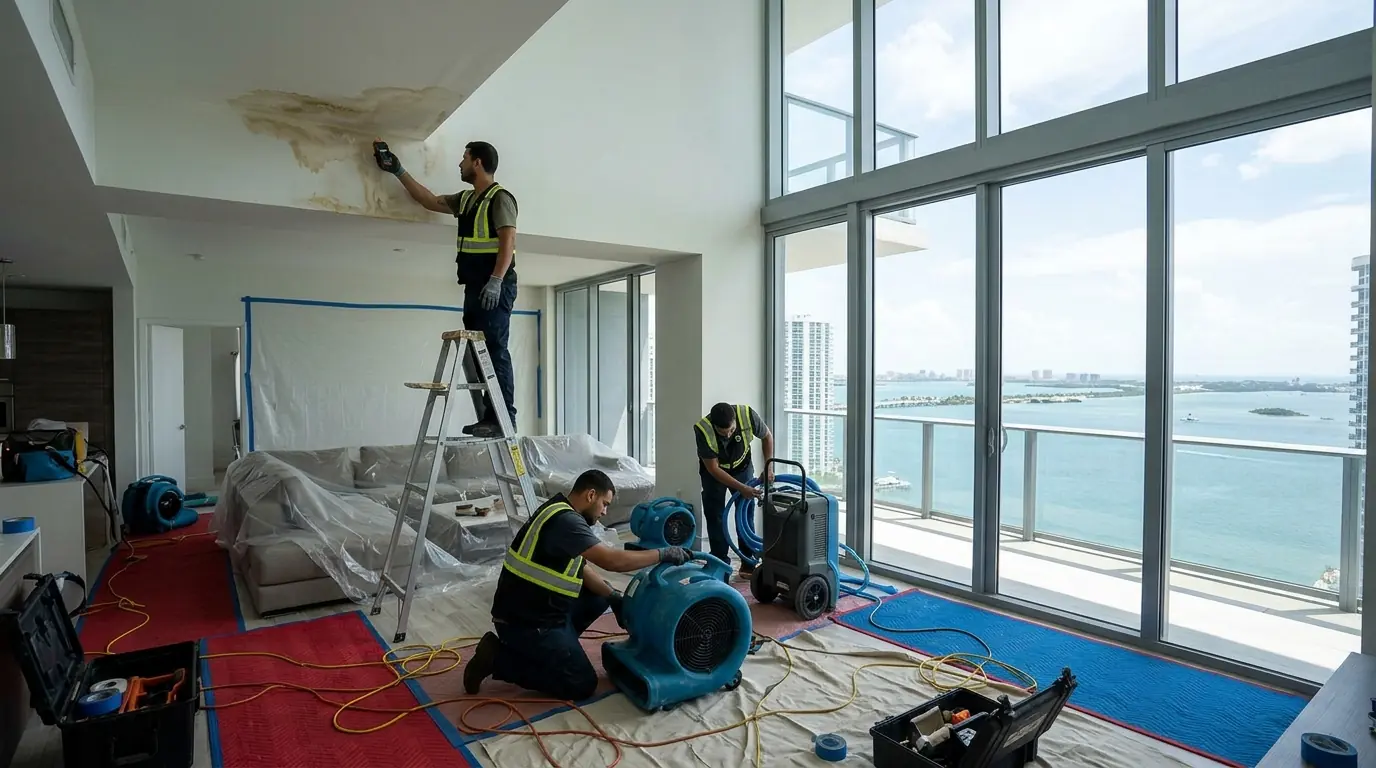
Restoration crew drying a stained ceiling and wall in a high-rise condo living room with Biscayne Bay views through the glass
Quick answer

Tell building management right away so they can find the source and shut off water to the right riser or unit. Then have a restoration crew read moisture in your unit and the ones above and below. Each affected owner gets their own photos and readings for their insurer, while the association handles anything in common elements. Responsibility depends on your condo documents.

Condo leaks are part plumbing problem, part building problem and part people problem. You have the unit where the water started, the units it reached, the association that controls common pipes and access, and sometimes several insurance carriers looking at the same event.

The restoration side stays the same in every unit: find all the water, dry it to a measured goal and rebuild what came out. What changes in a tower is the coordination, so the crew keeps separate readings and photos for each unit and hands them to each owner.
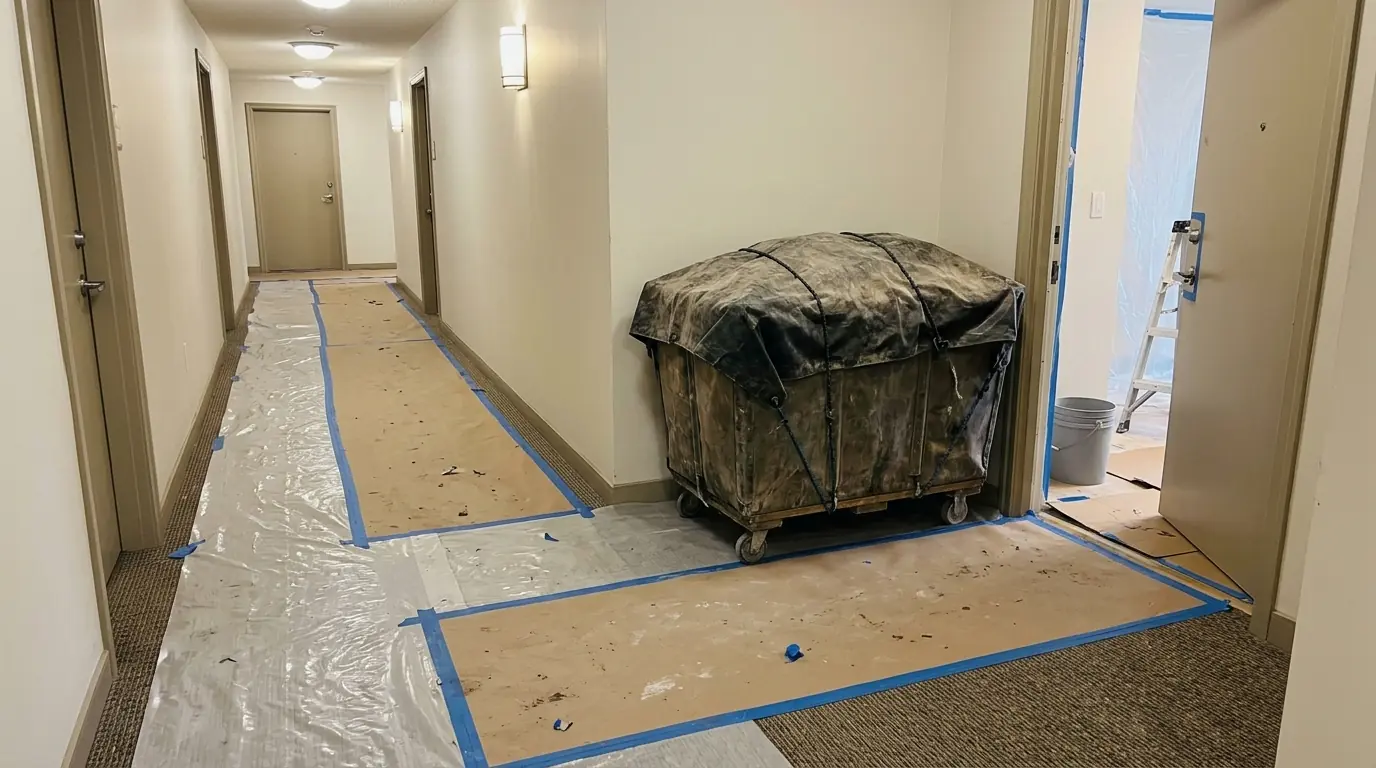
Floor protection and a covered debris cart in a carpeted condo corridor outside an open unit door

Who to call first in a high-rise

Call building management or the front desk before anything else. They know where the riser valves are, they can get into the unit above if the owner is away, and they log the event, which matters for the association's records.

Then call the crew. Restoration teams working in towers on Brickell Key, in Sunny Isles Beach or along the beach in Aventura plan around service elevators, loading docks and quiet hours, so let the dispatcher know your building's rules up front.

  • Give management your unit number and where the water is showing
  • Ask which unit is above and whether anyone is home
  • Photograph the ceiling, walls and floors before moving anything
  • Write down the time you first noticed the water

Following water across floors and walls

Water in a concrete tower finds the openings: pipe penetrations through the slab, gaps around plumbing stacks and the space above a dropped ceiling. It can show up in a unit diagonal to the source, not just straight below.

So the crew reads every unit it is given access to, not only the one with the visible stain. Ceiling drywall, the top of shared walls and the subfloor under tile or wood all get checked with meters, and hidden moisture detection confirms the edges of the wet area.

If the source was an AC drain or a supply line in the unit above, the cleanup there follows our AC leak or burst pipe process.

Signs to act on

When to call about condo leak restoration

  • Water dripping from a ceiling lightWater coming through a fixture usually means it has pooled above the ceiling from the unit upstairs.
  • A stain that grows from the cornerA ceiling stain that spreads from the corner near a bathroom or kitchen wall often traces back to the unit above.
  • Your neighbor below knocksIf the owner under you reports water, your unit may be the source even if your floors look dry.
  • Wet carpet in the corridorDamp hall carpet outside your door can mean water is running under the unit entry threshold.
  • Bubbling paint along the shared wallPaint blistering on a demising wall can point to a pipe in the wall or water from next door.
  • Low pressure on one riserWhen several units on the same stack report weak water at once, a common line may be leaking.

Your unit, their unit and common elements

Who pays for what depends on your declaration of condominium, the association's rules and the policies involved. In general, the association covers parts of the building it maintains, and owners cover their unit interiors and contents, but the exact line is in your documents.

Restoration does not settle that question, and under Florida Statute 489.147 a contractor may not interpret your coverage. What the crew can do is keep clean records for each unit, so every owner and the association can hand their adjuster something clear. Since SB 2-A, policies issued on or after January 1, 2023 cannot assign post-loss benefits to a contractor, so each owner works their own claim.

Working inside an occupied tower

Drying equipment runs day and night, and in a condo that means sound through shared walls. The crew sets units to keep noise reasonable and coordinates timing with management for any demolition.

Debris goes down in covered carts through the service elevator, never through the lobby. Floor protection stays down in halls, and work areas are kept closed off so dust does not reach the corridor.

Older towers may be going through milestone inspections under SB 4-D, passed after the June 24, 2021 Champlain Towers South collapse in Surfside. Those inspections are done by licensed architects or engineers and are separate from leak restoration, but if your association has engineering work underway, mention it so the crew can coordinate.

How the job runs

From your call to a finished room

  1. Coordinate with managementThe crew confirms the source is shut off, gets access to the units involved and books elevator time.
  2. Read every affected unitMoisture is mapped in the source unit and each unit above, below and beside it that management opens.
  3. Extract and protectStanding water is removed, floors and halls are covered, and contents are moved out of the wet zone.
  4. Open ceilings and walls where neededWet ceiling drywall and wicked wall sections are removed so the cavities can dry.
  5. Dry and log each unitEach unit gets its own equipment, its own daily readings and its own photo set.
  6. Rebuild and hand off recordsCeilings and walls are rebuilt and painted, and each owner gets the file for their unit.

Questions

Condo Leak Restoration questions

The leak came from the unit above me. Who calls the restoration crew?

Anyone can make the call, and fast action helps everyone. Often the source unit owner or management calls first, but you can call for your own unit too. Each unit gets its own records, so the question of who pays can be sorted out with the documents and the insurers.

Do I need the upstairs owner's permission to dry my own unit?

No, you can dry your own unit. To stop the source and dry the unit above, though, the crew needs access from that owner or from management. Drying your ceiling without fixing the source just means it gets wet again.

Can my wood or tile floor stay if water came through the ceiling?

Water from above often lands on furniture and floors and spreads under baseboards. Tile set on the concrete slab usually survives. Wood floors and laminate over a sound mat trap water and may need to come up, depending on readings.

Why are you checking units that don't show any water?

In a concrete tower, water travels along pipes and slab openings and can reach units that are not directly below. Meters find wet ceilings and walls before they stain. Checking now avoids a second leak call next month.

My building has strict work hours. Can drying still happen?

Yes. Drying equipment runs quietly enough to stay on overnight in most buildings, and noisy work such as cutting drywall is scheduled inside the hours management allows. Share the rules with the dispatcher so the plan fits them from day one.

Water, smoke or storm damage right now?

Call (786) 664-2643. A person answers at any hour, asks what happened, and tells you what to do while the crew gets moving.

Call (786) 664-2643 · 24/7