Skip to content
Water, fire, storm and mold calls answered 24/7 across Miami-Dade and Broward(786) 664-2643
New KingstonWater & Restoration · Miami(786) 664-2643Answered 24/7
Washer, dishwasher, fridge

Appliance leak cleanup in Miami

Appliance leaks start small and hidden, a cracked ice maker line behind the fridge or a dishwasher seal dripping under the cabinet, and by the time water shows at the toe kick, the cabinet base is often already soft.

Refrigerator pulled from its kitchen niche in a Miami home showing a cracked ice maker line and wet laminate floor
Quick answer

Turn off the valve behind or under the appliance, unplug it if you can do so without standing in water, and pull it out to see how far the water spread. Wipe up what you can, then have a crew read the cabinets, walls and floor. Washer and dishwasher water is gray water, so swollen cabinet bases and wet drywall often need to be replaced.

Every appliance with a water line is a leak point: the washing machine hoses, the dishwasher supply and drain, the refrigerator ice maker line and the sink disposal. Each one sits in a tight space against a wall or inside a cabinet, which is exactly where water hides.

The cleanup is about getting into those tight spaces. The crew pulls the appliance out, reads the cabinet floor, the wall and the slab under it, and dries or replaces what took on water. Your appliance repair technician or plumber handles the machine itself.
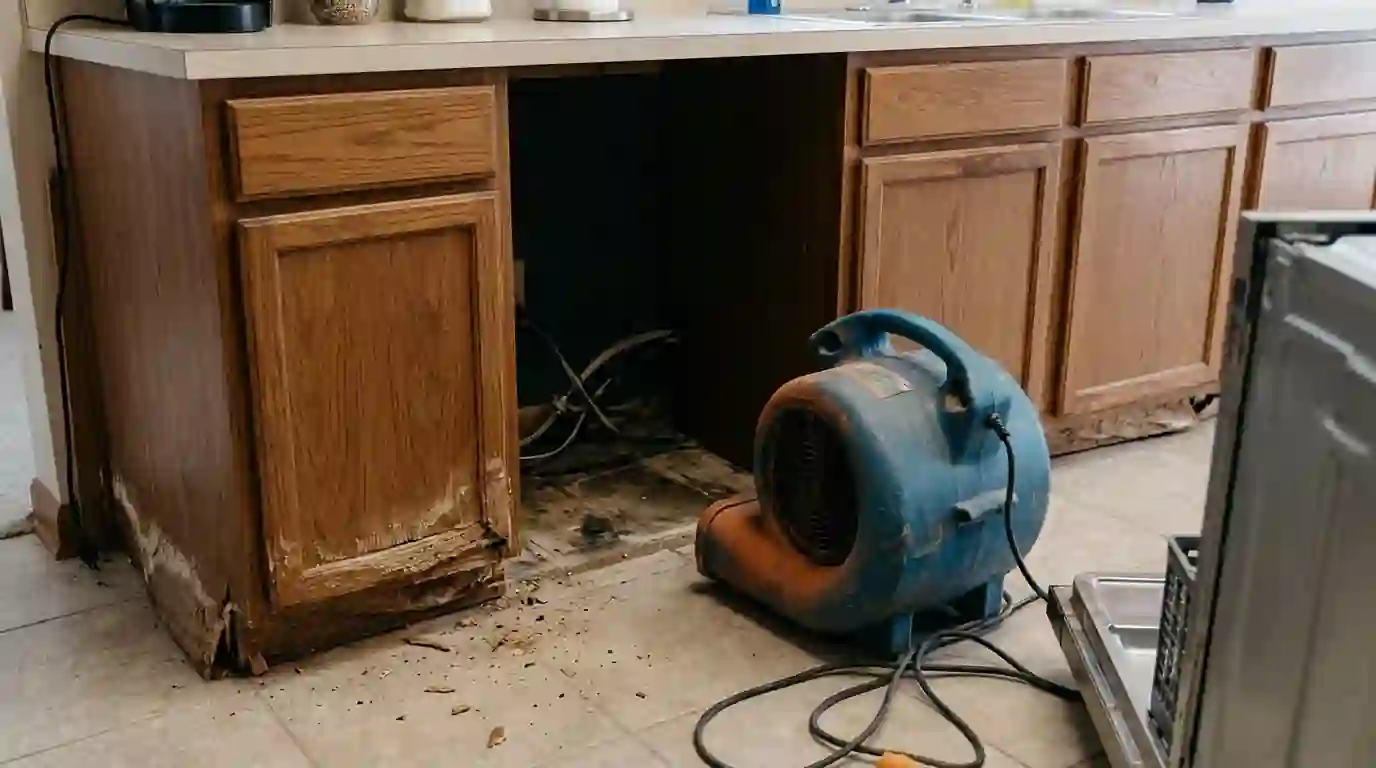
Dishwasher removed from a cabinet run with swollen particleboard toe kicks and an air mover blowing underneath

Ice maker lines: the slow leak behind the fridge

Many refrigerators connect to a thin plastic or copper line that runs from a valve under the sink or in the wall. Plastic lines get brittle with age and can crack where they bend, and copper lines can kink when the fridge is pushed back.

Because the leak is small and hidden, it can run for weeks. The water spreads under laminate or vinyl plank, wicks into the base of the wall and soaks the cabinet next to the fridge. Pulling the fridge forward and checking the wall and floor behind it is the first step.

Braided steel lines are sturdier, but they still need to be checked whenever the fridge is moved.

Dishwasher and sink cabinet damage

Dishwashers leak from the door seal, the supply line, the drain hose or the pump. The water usually runs out under the cabinets on either side, where the cabinet bases are often particleboard that swells and crumbles once it gets wet.

Water from a dishwasher counts as gray water under restoration guidelines based on IICRC S500, so wet cabinet bases and drywall behind them are usually removed rather than dried in place. Solid wood cabinet boxes sometimes survive, while the toe kicks and bottom panels get replaced.

When the cabinet damage is extensive, a kitchen rebuild replaces boxes and counters together so they match.

Signs to act on

When to call about appliance leak cleanup

  • Puffy cabinet toe kicksThe strip below kitchen cabinets swelling or peeling points to water under the dishwasher or sink.
  • A sticky or warped floor by the fridgeLaminate or vinyl plank that lifts near the refrigerator often means a slow ice maker line leak.
  • Water under the washerEven a small puddle under the machine can come from a failing hose or a drain that backs up.
  • Ice maker that stops making iceA fridge that stops making ice can mean the line has cracked and is leaking instead.
  • A drip from the dishwasher doorWater at the bottom of the door, or on the floor after each cycle, points to a worn seal or overfilling.
  • Odor from the sink cabinetA sour smell under the sink can come from a slow leak at the dishwasher drain or the disposal.

Washing machines in laundry closets

Washer hoses are under pressure all the time unless you turn the valves off, so a burst hose can flood a laundry room quickly. Drain hoses can slip out of the standpipe, and a clogged drain can back up into the room with each cycle.

In Miami homes, the laundry closet often shares space with the water heater or sits next to a bedroom or hall closet, so water moves under the wall into the next room. Our water heater leak page covers the heater side of that closet.

  • Replace rubber washer hoses with braided steel ones
  • Check that the drain hose is secured in the standpipe
  • Turn the washer valves off when you travel
  • Leave a little space behind the machine so you can look

Getting into the tight spaces

The crew pulls appliances out, opens toe kicks and removes the bottom panels of cabinets so meters can read the floor under them. Thermal imaging shows how far water has traveled along the wall and into the next room.

Drying in a cabinet run is targeted: air is pushed under the cabinets and into the wall cavity, and dehumidifiers run in the room. Materials that cannot dry in time are cut out cleanly so the replacements fit.

Once the area is dry, cabinets, baseboards and drywall are repaired, the appliance goes back in place, and your technician reconnects it.

How the job runs

From your call to a finished room

  1. Close the valve and unplugThe crew confirms the supply is off and the appliance is unplugged before pulling it out.
  2. Pull the appliance outThe washer, fridge or dishwasher is moved so the wall and floor behind it can be checked.
  3. Read cabinets, walls and floorMeters and thermal imaging show how far the water traveled under cabinets and into nearby rooms.
  4. Remove swollen materialsToe kicks, cabinet bottoms, baseboards and wicked drywall are removed and bagged.
  5. Dry under and behindAir is directed under cabinets and into the wall, with dehumidifiers running and readings each visit.
  6. Repair and resetCabinets, trim and drywall are repaired, and the appliance is ready for your technician to reconnect.

Questions

Appliance Leak Cleanup questions

Do I need new cabinets after a dishwasher leak?

Not always. Toe kicks and bottom panels can often be replaced while the cabinet boxes stay. If the boxes are particleboard and the bases have swollen or crumbled, or growth has started, replacing those boxes is usually the better fix.

How can I tell if my ice maker line is leaking?

Pull the fridge out and look at the line and the floor behind it. Water, a white mineral trail or a soft spot in the floor are clues. An ice maker that stopped making ice or a water bill that crept up can point the same way.

Is washing machine water dangerous to clean up?

Washer discharge is gray water that carries soap, lint and whatever came off the clothes. Wear gloves, keep children and pets away and wash up after. If the drain backed up with sewage, treat it as black water and leave it to the crew.

Can laminate flooring be dried after a fridge leak?

Laminate and many vinyl plank floors trap water underneath and swell at the joints. Planks that have lifted or swollen usually need to be replaced, and the floor beneath has to dry first. A crew can tell you which boards can stay.

What should I tell my appliance repair technician?

Tell them where the water came from, how long it may have been leaking and that the area is being dried. Ask them to keep any failed hose, line or part. That helps your records and helps the restoration crew plan the repair.

Water, smoke or storm damage right now?

Call (786) 664-2643. A person answers at any hour, asks what happened, and tells you what to do while the crew gets moving.

Call (786) 664-2643 · 24/7