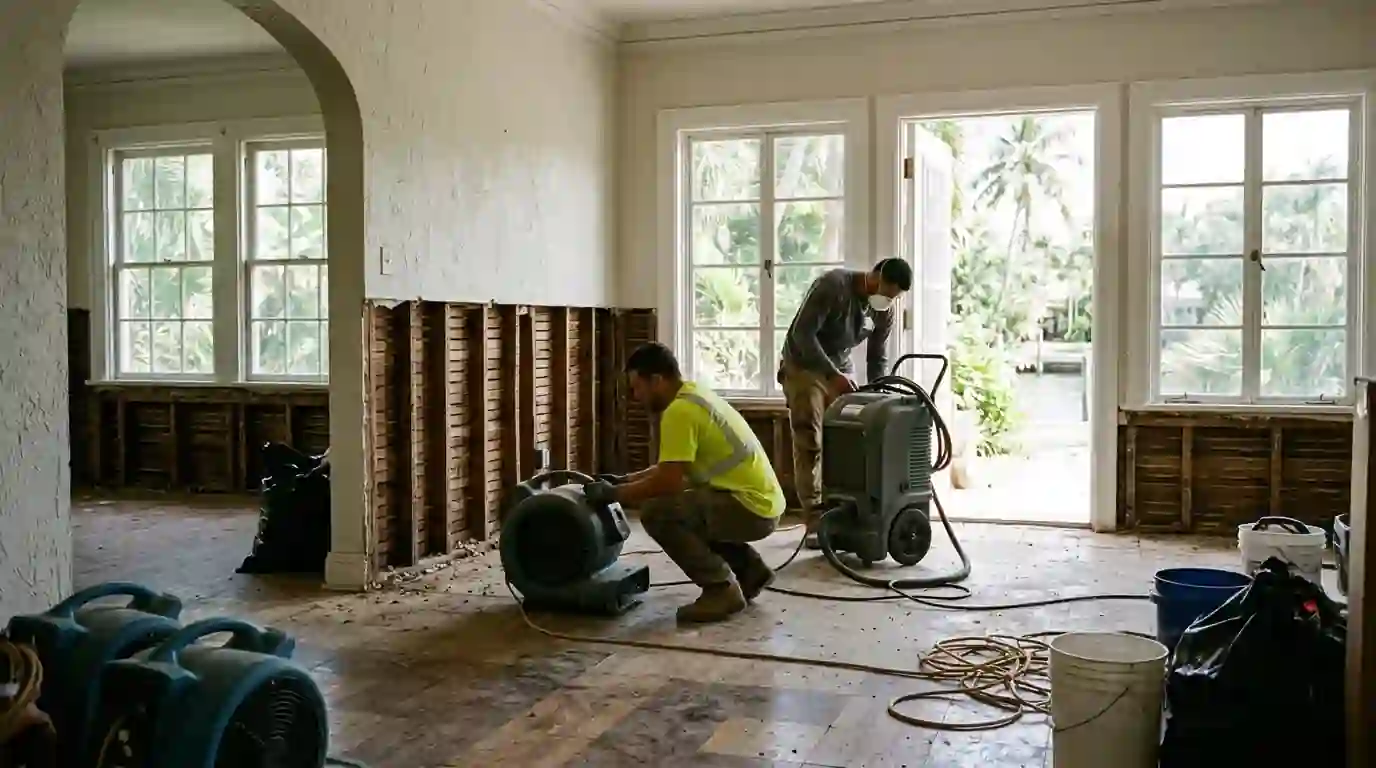
Yes, we handle flood and storm cleanup in Spring Garden around the clock. A crew extracts standing water, removes wet drywall, plaster and flooring that cannot be saved, sets drying equipment and logs moisture daily until the structure is dry. Exterior repairs on these historic homes go through City of Miami preservation review, so we document original materials before anything is replaced.
The neighborhood is tiny, about 0.15 square miles, and it became a City of Miami Historic District in 1997. Its designation report calls it the oldest intact single-family neighborhood still standing along the river. Many houses date from the mid-1910s to the 1940s, so the walls, floors and pipes we open are often original.
When storm or tidal water gets into one of these homes, the job has two goals: get wet material out fast enough to stop mold, and protect the historic character the city reviews.
A small peninsula with water on several sides
Spring Garden is bounded by the Dolphin Expressway to the north, the Seybold Canal to the east, the Miami River to the southwest and NW 12th Avenue to the west. Wagner Creek was dredged by about 1918 and renamed the Seybold Canal, with a turning basin, before the land was platted and sold for homes in the 1920s boom.
That means waterfront lots, seawalls of varying age and little elevation. When a storm pushes the river up or rain cannot drain off, ground floors flood first. Water from the river or canal counts as Category 3 under the IICRC S500 standard, so porous materials it touched usually come out during flood damage cleanup.
What a century-old house does with floodwater
Homes here run 80 to 110 years old. Plaster, old wood framing, original plumbing and early wiring all behave differently from modern drywall and plastic pipe. Plaster gives up water slowly, and old wood floors can cup or crack if they dry too fast.
Our crew opens only what has to come out, measures moisture in what stays and dries that in place. Daily readings go into a log that you and your adjuster can both use. Good structural drying in an older house is slower and more careful, not louder.
- Plaster walls: checked with a meter at several heights before any cut
- Wood floors: dried gradually under monitoring to limit cupping
- Old wiring: power stays off in wet rooms until an electrician says it is safe
Before a named storm, and the first hours after
Hurricane season runs June 1 to November 30, and fall king tides, roughly September through November, can lift the river and canal even on dry days. Before a storm, lift rugs, papers and electronics off the ground floor and take pictures of every room as they stand.
After the storm, call (786) 664-2643 once it is safe to be outside. If the roof is open or a window is broken, the first visit is about stopping more water with a secured roof tarp or plywood over the opening. Extraction and drying start right after.