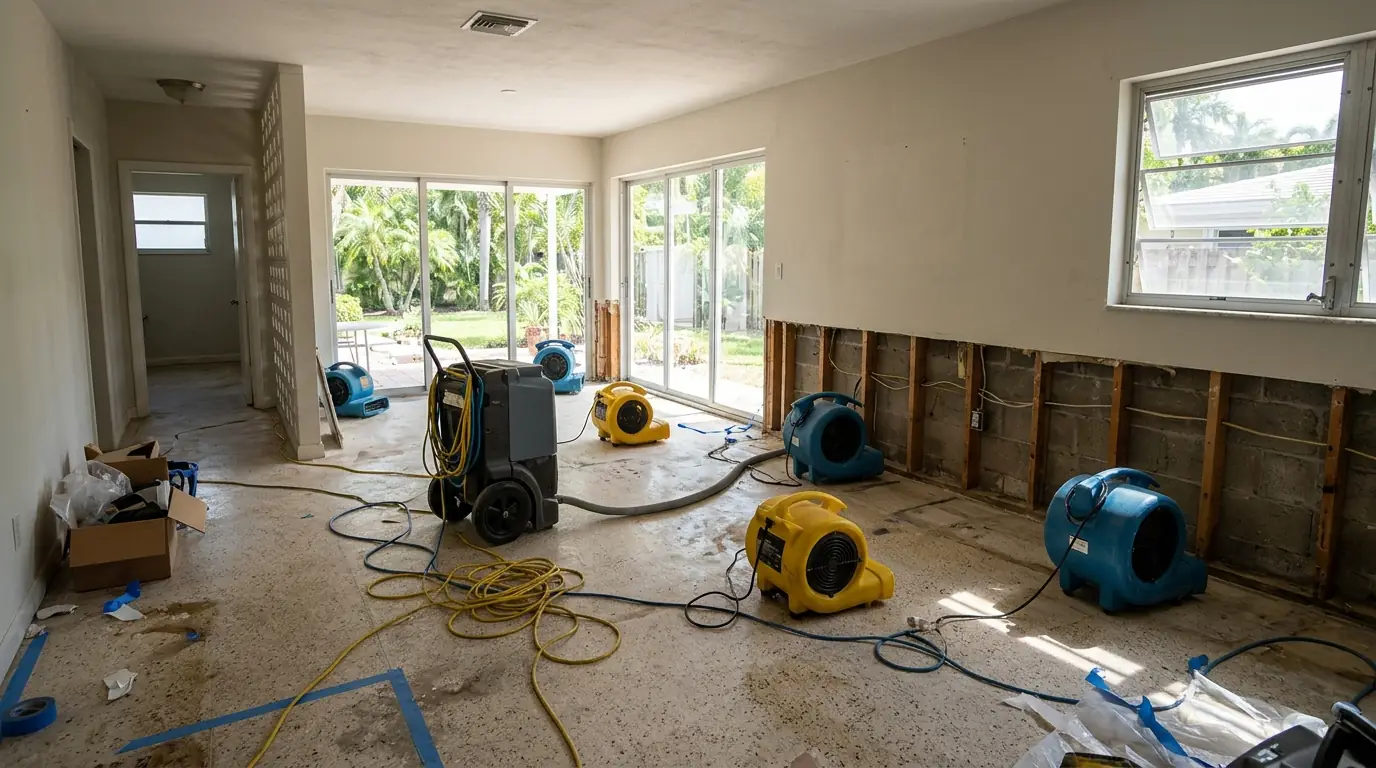
For flood, storm or leak damage in Belle Meade, call (786) 664-2643 any time, day or night. We extract water, remove soaked materials, clean and disinfect after bay or canal water, and dry the structure with daily readings. Flat MiMo roofs get tarped first to stop the rain, and the interior is rebuilt once everything is dry.
Belle Meade is a compact bayfront enclave east of Biscayne Boulevard, about 6 miles north of Brickell. The plat was filed on September 16, 1925, little was built until 1934, and by about 1960 the neighborhood held 396 single-family homes on 136 acres. Belle Meade Island, at the north end, is set apart by a 100-foot canal and reached by two bridges.
That much water frontage on so small a footprint shapes nearly every call we take there. Storm surge, king tides, flat-roof ponding and aging plumbing all show up, sometimes in the same house.
MiMo flat roofs and the ponding problem
Roughly 60% of Belle Meade's homes were built before 1960. Many are late-1940s and 1950s Miami Modern houses: low-slung, flat-roofed and trimmed with breeze block. They look great, but a flat roof that holds water after a summer storm will find every weak seam.
Leaks on these roofs often travel sideways before they drip, so a stain in the living room may start near a drain on the far side of the house. We trace it with moisture meters and thermal imaging, then open the ceiling only where readings show water. Breeze-block walls also let wind-driven rain through, so we check the walls beside any opening.
If rain is still coming in, an emergency roof tarp goes on first. Interior drying starts once the water has stopped.
Canal and bayfront lots after a storm
Bayfront and canal-front lots are exposed to storm surge, king tides and seawall overtopping. On the island, water is on every side. When a storm pushes the bay over a low wall, it carries salt, silt and whatever was on the street into ground-floor rooms.
We treat that water as contaminated. Our storm surge cleanup process cuts wet drywall above the waterline, pulls soaked insulation and flooring, washes salt residue off framing and block, disinfects and dries. Salt left in a wall keeps it damp, because it draws moisture from humid air.
- Wet drywall cut out above the waterline
- Soaked insulation, carpet, pad and laminate removed
- Framing and block rinsed of salt and silt
- Disinfection, then drying to a measured goal
Original plumbing in the older houses
Pre-1960 houses often still have their original plumbing and electrical systems. Old supply lines, cast-iron drains and corroded fittings fail quietly, under a vanity or inside a wall, and the first clue may be a musty smell or a soft baseboard.
Everything built since 1960 is infill or replacement on the original 1925 lots, including contemporary waterfront rebuilds. Those newer homes bring their own issues: large glass openings, complex roofs and big AC systems whose condensate lines can clog. We see both kinds of house on the same block.